|
|
Meaning of Money
Part 5
The social purpose of money
|
a. Creation of wealth
b. Full employment
c. Limitation and transfer of wealth
|
|
a. Creation of wealth
|
Money has a very useful social purpose in the creation of wealth. Compared to barter which is the other known alternative for economic exchange, money so greatly enhances economic activity from small businesses to large - that there is actually no comparison.
However, the downside to money has been that 'money' can become an end in itself. Money manipulators or money changers can then become the major cause of the collapse of the economic system by misallocating the real factors of production. Money then becomes a veil concealing, restricting and misdirecting the proper real economic activities.
|
|
|
|
|
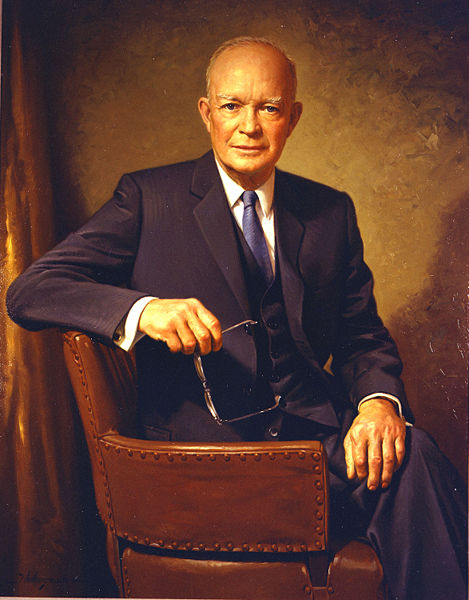
Dwight David �Ike� Eisenhower
(October 14, 1890 �
March 28, 1969)
34th President of the United States
|
Eisenhower Warned about
the Military Industrial Complex
"We must guard against the acquisition of unwarranted influence, whether sought or unsought, by the military-industrial complex... Only an alert and knowledgeable citizenry can compel the proper meshing of the huge industrial and military machinery of defense with our peaceful methods and goals, so that security and liberty may prosper together."
|
|
guns
|

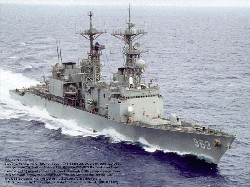
war ships
|

Trident missile launch |
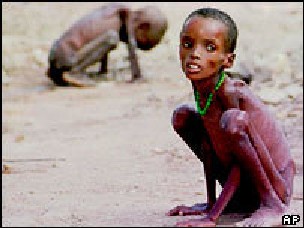
�Every gun that is made, every warship launched, every rocket fired signifies, in the final sense, a theft from those who hunger and are not fed, those who are cold and are not clothed.�

�The cost of one modern heavy bomber is this:
a modern brick school
in more than 30 cities.
�It is two electric power plants,
each serving a town of 60,000 population.

|
|
�It is two fine, fully equipped hospitals.�
�We pay for a single fighter plane with a half million bushels of wheat.
We pay for a single destroyer with new homes
that could have housed 8,000 people.�
|
Note by Bruce:
It seems to me quite likely that these costs are GREATLY UNDERESTIMATED in the terms of modern military technology since the time of Eisenhower. They also may not be reckoned near high enough if they do not include the costs of maintenance through the years and the interest upon the interest that is piled upon all these costs in the terms of deficit financing. Even greater are the costs and losses that result from the opportunities and benefits that have been lost from not making these expenditures into real capital investments for peace.
Economic charts projecting these resources having been invested in the education of the masses of the world, along with the production of capital equipment for their use, are exponential regarding what this planet could have produced in comparison to the millions of people that have been killed and the means of their livlihood having been destroyed.
|
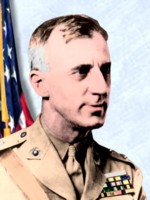
Major General Smedley D. Butler, USMC
(July 30, 1881 � June 21, 1940)
Holder of TWO medals of honor.
At the time of his death, the most decorated Marine in U.S. history.
|
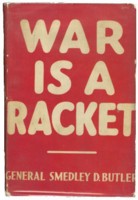
"War is a racket. It always has been. It is possibly the oldest, easily the most profitable, surely the most vicious. It is the only one international in scope. It is the only one in which the profits are reckoned in dollars and the losses in lives. A racket is best described, I believe, as something that is not what it seems to the majority of the people. Only a small 'inside' group knows what it is about. It is conducted for the benefit of the very few, at the expense of the very many. Out of war a few people make huge fortunes."
|
|
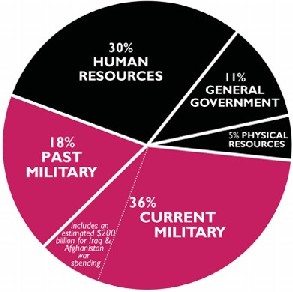
This chart is for US Fiscal Year 09 but the amount going to the military continues to increase from year to year. So do the war profits and the concentration of wealth in the US. There is a continuous cry for more war goods and how this president or that has sold out the country by depleting the war machine.
|
|
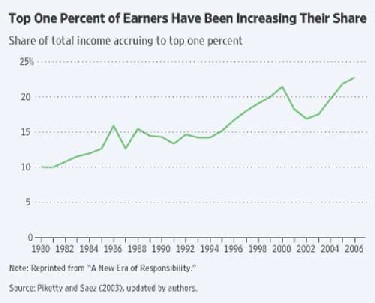
The wealthy keep getting wealthier and the poor poorer.
This chart shows that in the twenty-five year period between 1980 and 2005 the wealthy doubled their share of the total income from ten percent to well over 20 percent. While no figures are available it may be that the process has greatly accelerated in the current five year period.
|
|
------
|
b. Full employment
|


|
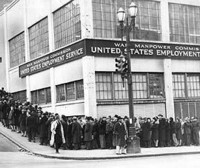
The first goal of an economic system should be full employment of its human capital. Money can, and should be, created for this purpose. Definitions of full employment involve subjective values regarding quality and volume of growth and progress versus stability and stagnation.
There is endless talk about the dangers of the welfare state but most people just want to be productively employed. The real welfare bums are the giant corporations that live out of the government's coffers. Oftentimes their managers receive millions of dollars while mother's on welfare do not have enough to properly feed their children.
The claim that people are not willing to work is not based in reality because they line up looking for jobs at the same time tens of thousands are being laid off all over the country. It is not a one time occurance. The system has resulted in repeated recessions - one after another with masses of people suffering great hardship.
One piece of advice is that people should better prepare themselves to be employable - but there are millions who have gotten education and still cannot find a job that anywhere near matches their training and capability.
|
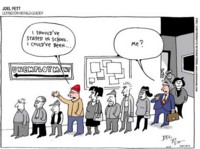
The fellow in front says that
he should have stayed in school
and the fellow behind says
that he did.
|

This Ph.D says that
he will work for food.
|

Many university graduates end up
on the street without a job.
|
|
Note by Bruce:
The first concern of economic policy and monetary policy should be full employment. If there is not full employment then resources are being wasted - which is certainly not being efficient although traditionally it has been said that efficiency is the watchword of economics.
Capital that is not used - deteriorates and wastes away. This is true whether we are speaking of real physical capital, human capital, or spiritual capital. It is not just the wasting, but also the real suffering involved that should concern us.
As always it is important to emphasize that real capital is not money. Money is not a store for real capital and it is a serious misdirection to hold that the primary purpose of money is as a store for wealth. Yet, that is the primary concern of monetarists, and especially metal-based moneterists in their continuous chatter about inflation and deflation. Those who wish to store wealth for the long term can store it in gold or any commodity they choose.
Admittedly, there needs to be stability in a monetary system to provide security in contracts and so forth - but should that fail - so long as there is full employment there will be no real loss to society. Therefore society should work to maintain full employment and adjust the monetary system as needs be, which is the very opposite of what has been economic policy in the past and as it continues to this day.
|
|
------
|
c. Limitation and transfer of wealth
|
|
Through money mechanisms various social purposes of a society can be obtained. The end result is always the determination of how the community's resources will be employed or left unemployed. One example would be the transference of resources from consumer products to military production, but any socially desirable end, such as the building of roads and schools, may be used as an example.
|
Taxation, by a money creating authority, has one and only one purpose and that is to transfer wealth from one class to another. Generally it is used by wealthier classes in power to transfer wealth from the lower classes and this is done while using the media which they control to brainwash the masses into believing that the opposite is happening.
Taxation therefore prevents a class from using wealth that it has obtained but as far as having a purpose of paying for goods and services it is totally unnecessary in a system which creates fiat money because that system can create whatever amount it wishes for its purposes. In fact that is the procedure in most modern economies.
|
Understanding taxes
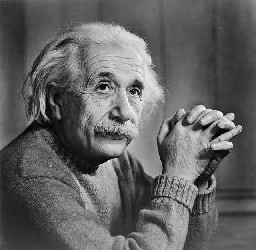
Albert Eistein, Jr.
14 March 1879 � 18 April 1955
"The hardest thing in the world to understand is income tax."
Albert Einstein."
|
|
Expansion of fiat money as a method of taxation is a universal application of the tax that no one can evade. Its drawback is that it can't be targeted at any group and so strikes the rich and the poor alike. If one is looking for a progressive tax that is directed towards the wealthy who have more discretionary income - then this is definitely not the way to go.
The only limit to a government pursuing its activities are the limitations of the real factors of production and so long as there is not full employment there is no economic reason for them not to pursue them. Very seldom has full employment occurred in any modern society. The concern about it occurring and causing inflation is generally a class action designed to minimize wage transfers to the labor force and to psychologically manipulate workers' willingness to be exploited.
|
|
Click here to:
go back to the Index
or to go on to Part 6
| | | |